 New data from the largest analysis to date on physician salaries shows that over the course of a career, female physicians make an average $2 million less than their male counterparts, a 25 percent pay gap. This survey of more than eighty thousand physicians, reported by Azeen Ghorayshi of the New York Times and published in Health Affairs, is the first to estimate the cumulative impact of gender pay gaps in medicine. Survey data was collected between 2014 and 2019. The study’s lead author, Christopher Whaley, a health economist at the nonpartisan think tank RAND Corporation, suggests that the gap may be even wider now given that other studies show the pandemic has driven women in many fields out of the workplace.
The self-reported salary data was collected at the social network Doximity, which is similar to LinkedIn and claims to reach 80 percent of doctors in the United States. The analysis compared wages between women and men with the same amount of experience and controlled for differences in specialty, type of practice, and patient volume. The study did not include data on people who identify as nonbinary or transgender, which are factors known to influence physician pay. Racial disaggregation of the data was also not possible because, as noted by Whaley, salary information for physicians by race “is not systematically recorded really anywhere.”
The study findings, as reported by Ghorayshi, include the following sober statistics:
- Female doctors make less than their male counterparts starting from their very first days on the job.
- The salary gaps started at the beginning of doctors’ careers and continued to widen until around their tenth year without recovering. The gap remained stable for the rest of their forty-year careers, with women never catching up to men.
- When comparing wages between men and women with the same amount of experience, male physicians over a forty-year career earned an average of $8.3 million while women earned roughly $6.3 million—a nearly 25 percent difference.
- Even within specialties, the wage gaps were sizable. For example, the highest gap was among surgeons at around $2.5 million and lowest among primary care physicians at nearly $920,000.
Ghorayshi notes that other studies have shown widespread bias against women in both academic and applied medicine, as well as in other fields. She writes that while “almost all professions still pay women less . . . the gap is wider among health care practitioners than among people in computer and engineering jobs.”
According to Ghorayshi, “While roughly the same number of women graduate from medical school as men, women make up only 36 percent of working physicians.” Snigdha Jain, a pulmonary and critical care physician at the Yale School of Medicine, suggests that one source of the “leaky pipeline” might be that women are in the prime of their reproductive years when they start practice, and they experience “insufficient maternity leave, inadequate support on return to work and a disproportionate burden of child care in the subsequent years.” Per Whaley’s suggestion, “Offering more paid family leave and more flexible scheduling,” along with making salary information more transparent, could help women “earn their fair share.”
All women in all professions would benefit from these policy changes. We need to put pressure on our lawmakers to put these policies in place.
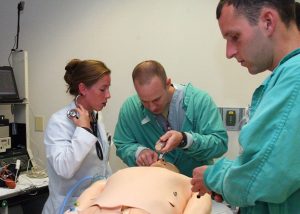
Photo courtesy of Army Medicine (CC BY 2.0)
 I remember when my high school guidance counselor advised me not to enroll in advanced science and math courses. He told me that girls were just not good at math and science and these courses would be a waste of my time. I kid you not, this really happened. And I believed him and did not consider career paths that required college math and science courses. After I graduated from college, I realized, “Wait a minute! I actually am good in math and science.” In fact, I had taken a number of advanced math and science courses in college for pass/fail grades as elective courses that did not count toward any major. I enjoyed them and did well in them. Once I graduated and realized the discrepancies in my beliefs and experiences, it felt too late to choose a different path, such as medical school, which would require me to start over.
 It has been about twenty years since the Los Angeles Fire Department upgraded their fire stations to add women’s locker rooms and restrooms. These changes were intended to reflect a commitment to create an inclusive environment for women to join the LAFD, where they could realize their dreams and add their talents and passions to community service as firefighters. Libby Denkmann, writing for the 19th, reports that twenty years later,
  The issue of paid family leave has recently resurfaced as a topic of debate in the United States because we are the only wealthy Western country that does not provide it. I have written in previous posts about the possible reasons why it has not been made available in the United States and why paid parental leave is a policy that would benefit both mothers and fathers. Still, the focus in public debate remains on paid leave, and parenting, as a women’s issue, is a private matter not of concern in the public realm even with evidence to the contrary revealed during the COVID-19 pandemic.
 Ageism in employment has been well-documented, especially for women. In a
  I want to bring to your attention some new cracks in the glass ceiling. Let’s celebrate some good news today.
 A new study from Yale researchers, led by Tristan L. Botelho, found clear evidence of
  A confusing set of dynamics is happening in the US workforce these days. Perhaps you have noticed, as I have, that
  New research conducted by Fidelity over a ten-year period found that its
  New research conducted and published by Jessica Nordell and Yaryna Serkez measures the