Why There Are So Few Senior Women on Wall Street

Why are there so few women in senior management in the banking and investment industry, also known as Wall Street? In spite of a plethora of diversity committees, women’s leadership programs and retreats, and inclusion training in Wall Street firms for at least the last two decades, the representation of women in senior positions has not changed much. A major investment bank has never had a female CEO, and only 2 percent of hedge fund managers are women. Sam Polk, a former hedge fund trader, explains in an article in the New York Times that the hypermasculine culture of Wall Street firms remain unchanged because “men rarely do or say anything” to challenge the overt and covert sexism all around them. The pressure to conform and fit in to be promoted is reinforced from day one. The overt sexism that women experience, such as pressure to sleep with bosses, retribution when they don’t, and loss of opportunity after taking maternity leave, is one type of sexism that creates barriers for women, but it is covert sexism that Polk is most concerned with in his article. He explains that “most of the sexism on Wall Street occurs when women aren’t in the room.” He calls this “bro talk,” where men casually talk about women as sex objects and body parts as a way of bonding with each other. Polk reflects on his own experiences in high school, in college, and as a bond trader on Wall Street where he heard men who were role models—fathers, coaches and bosses—denigrate women. He notes that while he felt uncomfortable hearing and participating in this type of talk, he never said so because “it feels really good to be in the in-crowd.” Protesting would have been “embarrassing and emasculating” and, he admits, bad for his career. Now the father of a daughter, Polk regrets his silence and explains, “‘Bro talk’ produces a force field of disrespect and exclusion that makes it incredibly difficult for women to ascend the Wall Street ladder. When you create a culture where women are casually torn apart in conversation, how can you ever stomach promoting them or working for them?” He urges men to be allies—to finally bring about change in the Wall Street culture and other organizational cultures they are in, men must insist that women be spoken about with respect. He makes the point that a relationship exists between “bro talk” and the rape and sexual abuse of women and girls. Polk states, “When we dehumanize people in conversation, we give permission for them to be degraded in other ways as well. . . . Our silence condones this language.” In another article describing the new movie Equity about female executives on Wall Street, author Melena Ryzik interviewed women who are currently investment bankers who agree that the culture of hypermasculinity still exists. They detail a number of sexist assumptions and double binds that create barriers for women:

  • The assumption that women will leave to marry or have children so there is no reason to promote them.
  • The demand that women have to continually prove themselves before they get promoted, while men are given a chance to prove themselves after promotion.
  • The conflict between being too tough or too pliant and being called overbearing when expressing an opinion.
Barbara Byrne, an investment banker at Barclays and a producer of the film, asks, “When do we get our fair share, when do we get a seat at the table?” It will take both women and men to change the culture of sexism. Let’s hope that many men heed Polk’s call for an end to their silence. Are you a man, or do you know a man, who speaks out when other men are demeaning women behind closed doors? We need men to stop participating in “bro talk” and challenge other men to stop, too. It will help us all to hear your success stories.   The image in this post is in the public domain courtesy of Helpsg.  ]]>

Gender-Neutral Family-Friendly Policies: The Unintended Consequences for Women

Where are the senior women scholars? Universities have been concerned about the underrepresentation of women at senior tenured levels for more than twenty years, especially in the STEM (science, technology, engineering and math) disciplines. I wrote about several studies seeking to explain this dearth of senior women scholars in a previous article. In response to the underrepresentation of women, many of these institutions implemented gender-neutral family-friendly policies in the 1990s. Justin Wolfers, an economist writing for the New York Times, reports new research on the careers of economists in the United States that shows surprising, unintended consequences of these policies for female economists. Wolfers reports that in fact, some gender-neutral policies have advanced the careers of male economists at the expense of women’s careers, which is probably also true in other disciplines. The specific gender-neutral policy under investigation here is the tenure extension policy, which grants one extra year to the seven-year tenure process to both women and men for each child. The intention of this policy is to create some family-friendly flexibility in the early years of an academic career, when the pressure to achieve tenure (publish or perish) in order to keep an academic job collides with the years when young women and men are ready to start families. Wolfers reports that new research by three economists—Heather Antecol, Kelly Bedard, and Jenna Stearns—shows a significant differential impact of the tenure extension policy on the careers of women and men. These researchers compiled data on all untenured economists hired over the past twenty years at fifty leading economics departments. They then compared promotion rates at institutions with tenure extension policies to those without them. This is what they found:

  • Tenure extension policies resulted in a 19-point rise in the probability that a male economist would earn tenure at his first job.
  • In contrast, women’s chances of gaining tenure at their first jobs fell by 22 percent.
  • Before the implementation of tenure extension, a little less than 30 percent of both women and men at these same institutions gained tenure at their first jobs. Consequently, the new policy significantly decreased the number of women receiving tenure.
One of the main flaws in the logic behind the gender-neutral tenure extension policy is that women and men experience the same distractions from their writing and research after the birth of a child. Wolfers cites Alison Davis-Blake, dean of the University of Michigan’s business school, as saying, “Giving birth is not a gender-neutral event.” Wolfers goes on to observe that “women receive parental benefits only after bearing the burden of pregnancy, childbirth, nursing, and often, a larger share of parenting responsibilities. Yet fathers usually receive the same benefits without bearing anything close to the same burden.” In fact, the study authors found that men who took tenure extension used the extra year to publish their research, resulting in higher tenure rates. No parallel rise in publication rates was seen for female economists. One of the study authors, J. Stearns, cautions that not all gender-neutral family policies are harmful. She notes that standard parental leave policies for both parents have reduced the stigma for women. Let’s note that it took female economists to uncover the harmful impact of this tenure extension policy on women—and there are not many female economists. What other unintended consequences could be negatively accruing for women from well-intentioned family-focused policies? What else might we be discovering if we had more female economists asking these questions? Do you have experiences or thoughts about the possible unfair impact of employment policies where you work? Let me know.   The image in this post is in the public domain courtesy of anekarinebraga.]]>

Hillary Clinton and Theresa May: How Gender Bias is Still with Us

Every so often things happen in the world that, for a moment, make underlying biases and stereotypes visible that are usually underground and hard to see. I believe this happened in the United States with the subtle, and not-so-subtle, emergence of racism when Barack Obama ran for president, was elected, and tried to govern. I believe gender bias and sexism are emerging now with the first-ever nomination of a woman, Hillary Clinton, by a major party for the presidency in the United States, and with the election of Theresa May as Britain’s new prime minister. Julia Baird of the New York Times writes, “The fact that a cluster of men lead the world merits no comment. But if women start to slowly enter the ranks—Theresa May, Angela Merkel in Germany, possibly Hillary Clinton in the United States—it’s treated as . . . some kind of gynocratic coup d’etat: a new ‘femokratie’ . . . the ‘dawn of a female world order. ’” One British paper warned, “The women are coming!” Baird notes that several insulting stereotypes have been used to describe May as a leader, including the Nanny (because she will now have to “mop up” after the Brexit mess created by her male counterparts) and the Thatcherite label of Iron Lady because she is known to take strong positions and be persistent. Baird observes that “our notions of mature women in power urgently need updating.” In the online publication Vox, Ezra Klein surfaces some other sources of gender bias in presidential politics when he tries to understand and explain the gap between Clinton as a public speaker—described as careful, calculated, cautious and uninspiring—and Clinton described by staff and colleagues as brilliant, funny, thoughtful, effective, and a good listener. Being a good listener is the hallmark of Clinton’s campaign style. In 2000, she conducted her senate campaign in New York State by doing “listening tours.” She won her senate seat against long odds because she listened and came to deeply understand what people in New York cared about. Once in office, she got legislation passed that addressed the concerns of her constituency. But, as Klein writes, “modern presidential campaigns are built to reward people who are really, really good at talking”—not listening. Klein goes on to point out that “we ran a lot of elections in the United States before we let women vote in them—a process developed by men, dominated by men and, until relatively late in American life, limited to men. ” Our election process also favors traits particularly prevalent in men—talking over listening. Klein cites one of my favorite gender linguistics scholars, Deborah Tannen, who explains that women value listening to build rapport and relationships. She contrasts this preference with that of men who emphasize the status dimension of communication—talking to increase status, or to win, versus listening to gain allies and build coalitions. A point by Klein that I find most interesting is that “presidential campaigns are built to showcase the stereotypically male trait of standing in front of a room speaking confidently—charismatic oration versus deep relationship.” Klein also offers observations by Brookings scholar Elaine Kamarck, author of Why Presidents Fail and How They Can Succeed Again. She found that “successful presidential leadership occurs when the president is able to put together and balance three sets of skills: policy, communication, and implementation.” Campaigns only test communication. Clinton is criticized for not being an inspirational speaker, but she has a long track record of making policy and getting things done in government through relationship and coalition building. While I agree that she has made some mistakes in her political career, isn’t it sad that her depth of policy and legislative experience and her track record for getting things done are overshadowed by an opponent who is all entertainment bluster with no accomplishments or experience in governing? Trump loves to talk about the process being “rigged” against him, but it seems to me it is actually rigged for him as a man who loves to talk to large audiences and increase his status by putting other people down. This is a form of gender bias I had not seen before, and it explains a lot. Is it new to you, too? What other gender bias is getting clearer for you in this election? Please share your observations in the comments section.   The image in this post is in the public domain courtesy of Jens Junge.]]>

How Women Decide: A Book Review

Therese Huston has written an important new book: How Women Decide: What’s True, What’s Not and What Strategies Spark the Best Choices. The book combines her own research with a comprehensive review of literature on gender differences in decision making. Some of her findings disprove stereotypes about gender differences, while others confirm and explain differences in decision making between women and men. To address these differences, Huston offers decision-making strategies for women. She notes, “Books with advice on decision making for men can be terrible for women. . . . Women need their own playbook.” This is the best playbook on decision making for women I have seen. Here are some of the findings and strategies that stood out for me.

Some Challenges for Women

Huston notes these and other challenges that women face as decision makers in organizations:
  • Women face underlying sexist assumptions that they can’t be trusted to make big decisions. A man only has to worry about making a judgment when making a big decision, while a woman has to worry about making the judgment and being judged because her judgment will be questioned.
  • If a man makes one pivotal decision for his organization, it will carry him a long time. Williams and Dempsey note that women, on the other hand, experience the “prove it again bias” as their good decisions are considered to be a fluke.
  • Women’s decision making is also impacted by something Huston calls “stereotype threat,” or the fear of living up to negative expectations that others have of your group. This fear can create distraction and anxiety for women that can result in hesitation and underperformance. I experienced stereotype threat as a young woman when my high school guidance counselor told me, “Girls are not good in math.” I became terrified of math and avoided it throughout college, thereby limiting my career options in significant ways. I later discovered that I am actually quite good in math, but my anxiety and hesitation from this stereotype threat limited my options. Women may avoid leadership positions and fear decision making for similar reasons.

Some Ways Women and Men are Equal as Decision Makers

Huston debunks a number of myths and stereotypes about men’s and women’s decision-making abilities:
  • Although many people believe that men are more decisive than women, scientists find that men and women struggle with their options equally.
  • Stereotypes suggest that women make decisions intuitively while men make decisions analytically. There is, in fact, no such term as “men’s intuition.” However, Huston reports that men get gut feelings about decisions as often as women, and women are as analytical—perhaps more so—than men in decision making because they know their decisions will be questioned and their case must be solid.
  • Men can read emotions and body language—both important sources of data for decision making—as well as women, but they don’t feel as motivated do so. Women are more motivated to pay attention to nonverbal cues as a self-protection skill because they have less power.

Differences in Risk Taking

Although men and women are equally skilled decision makers, significant differences exist between women and men in making risky decisions. Huston reports:
  • Risk taking is a skill, not a personality trait, and boys get more encouragement to practice this skill than do girls.
  • Several studies show that men overestimate their knowledge and abilities while women underestimate theirs. Overconfidence has been shown to be a major obstacle to smart decisions. Women’s more accurate self-assessment means fewer errors in judgment.
  • Neuroscience has uncovered evidence that the spike in cortisol levels produced by stress has the opposite effect on men’s and women’s approaches to risky decisions. The most stressed-out men pursue options that have big costs and a small chance of big benefits, while the most stressed-out women go for the smaller, more guaranteed success.

Effective Decision-Making Strategies for Women

Huston offers practical strategies for women at the end of each chapter. Here are some that I found particularly thought-provoking and useful:
  • Use your intuition, an important source of data, as a starting point in your decision-making process—but only trust it up to a point. Then hunt down the data to ground your decision before you make it. Don’t rely on intuition alone.
  • When you are talking about your successes in a job interview, draw attention to the successful risks you have taken. This will help counteract the stereotype that women are not decisive and do not take risks.
  • Keep your confidence dialed down when making a decision to ensure it is grounded and smart. Then dial your confidence up when you need to sell your decisions to others.
Women receive a lot of mixed messages and are subject to many confusing double binds as leaders and decision makers. Huston offers an important playbook for how women can navigate these minefields and leverage their strengths. Reading this book will open your eyes and give you practical strategies for overcoming the challenges of making decisions as a woman. Let me know what you think.   The image in this post is in the public domain courtesy of Helpsg.  ]]>

Myths about Women’s Relationships

One of the most enduring myths about women is that women are mean to each other and undermine each other at work because of the Queen Bee Syndrome. Some women do have stories of sabotage by another woman at work. My research, published in my book, New Rules for Women: Revolutionizing the Way Women Work Together, found examples of this type of behavior between women but also identified ways that organizational systems set women up against each other. In fact, this behavior between women is no different than the same behavior reported by all marginalized groups. Token representation sets marginalized group members against each other to compete for limited opportunities in environments controlled by dominant group members. This behavior is not unique to women. The participants in my study also talked about the importance in their lives of women’s support. Several new studies, reported by Sheryl Sandberg and Adam Grant in the New York Times, confirm that strong evidence exists to knock a hole in “the myth of the catty woman.” Here are some of the findings from those studies:

  • When researchers studied the top management of the Standard and Poor’s 1,500 companies over twenty years, they found that when the chief executive was male, it was unlikely that more than one woman would make it onto the senior management team. When the chief executive was a woman, more women joined senior management.
  • On corporate boards, women are less likely than men to be mentored or promoted to senior management positions—unless there is already a woman on the board.
  • In Latin American politics between 1999 and 2013, female presidents appointed 24 percent more female ministers to their cabinets.
  • When women negotiate on behalf of other women, they are able to boost their own salaries, too.
Yes, there are still some Queen Bees in organizations, particularly in male-dominated ones where opportunities for women’s advancement are limited. And men can also be quite mean to each other, though their behavior is often viewed as healthy competition and has no name equivalent to Queen Bee. Let’s look for ways to lift each other up and move past negative stereotypes about women. For the most part, these stereotypes are not true and definitely not the whole story. Here are some ways that women can continue to support each other:
  • By mentoring each other and being role models for supporting women.
  • By celebrating each other’s accomplishments, especially when they are overlooked.
  • By helping each other get heard in meetings.
  • By talking with each other and agreeing to compete and have each other’s backs. Yes—we really can do this!
If you have experiences supporting or being supported by women in your workplace, please share them in the comments section.     The image in this post is in the public domain courtesy of Startup Stock Photos.]]>

A Gender Gap for Female Attorneys: Where Are the Women?

Even though women make up close to half of all law school graduates, Shirley Leung of the Boston Globe notes that a gaping gender gap exists in the legal profession. She speculates that it could be the long hours required by large firms, the male-dominated culture of those firms, or outright discrimination, but “women drop out.” Leung reports that

  • Women comprise only 36 percent of the profession, according to the American Bar Association
  • Only 18 percent of women are equity partners at the largest firms
  • Women earn only 80 percent of the typical equity partner, according to a study done by the National Association of Women Lawyers
  • In high profile cases, women may be on the litigation teams, but they are relegated to roles behind the scenes and do not have speaking parts
Why does this last point matter? Leung cites Kim Dougherty, past president of the Women’s Bar Association, as noting, “getting more women to play big roles in courtrooms increases their chances for advancement, better pay, and opportunities to seek judgeships, which require lead trial experience.” Both Dougherty and Nancy Gertner, a retired federal judge, suggest that judges can impact change from the bench by asking for more gender diversity among attorneys in courtroom proceedings. By setting such policy for their courtrooms, they can open opportunities for women to litigate in lead roles. The judge presiding over the Sumner Redstone case in Boston is a recent example of a judge who “walks his talk.” When only male attorneys spoke for both sides in the opening arguments of the trial, Judge George Phelan commented on the lack of female attorneys. His comment may result in participation by more women lawyers as this case moves forward, but Gertner notes that this will only matter if the women have real speaking roles rather than just cameo appearances. We need more judges like Phelan and Gertner who create fairness and opportunity for all lawyers in their courtrooms.   The image in this post is in the public domain courtesy of Activedia.]]>

Why We Need More Women on Corporate Boards

The wealth gap in the United States is outrageous, as highlighted previously by the Occupy Wall Street movement and progressive Democrats like Elizabeth Warren and Bernie Sanders. The pay of corporate CEOs continues to skyrocket, even when their companies underperform, while millions of citizens struggle to earn a living wage. The earnings of the middle class have been in steep decline, but corporate boards approve ever-increasing compensation packages for CEOs. I always assumed that if more women were on corporate boards, there would be a reversal of this trend—but new research shows the opposite. While past studies show that having more women on boards is good for company performance, Gretchen Morgenson of the New York Times reports that according to a new study, “companies with greater gender diversity on their boards paid their chief executives about 15 percent more than the compensation dispensed by companies with less diverse boards.” Why might this surprising trend be happening? Morgenson notes that while no one knows for sure, some experts point to the following possible causes:

  • Relatively few women (roughly 20 percent) serve on corporate boards, and those who do may feel pressured to go along with the “vote yes” culture of most boards in order to keep their seats.
  • The board compensation committee determines CEO pay, and women do not commonly serve on these committees, much less as chairwomen. Morgenson notes that last year, only two out of ten committee chairs of the most diverse boards were women.
  • The same women directors often hold multiple positions. Morgenson notes that nearly one-quarter of women directors at S&P 500 companies held multiple board seats compared to 19 percent of men. This group of women might be sought after because they do not rock the boat.
Many qualified women with C-Suite experience have not been tapped to serve on corporate boards. It seems likely that a larger proportion of women on boards will create space for more women to join together to resist the “culture of yes” and help bring CEO pay back to more reasonable levels. Token representation makes it difficult to speak out. Let’s keep pushing for more women on boards.   The image in this post is in the public domain courtesy of Benjamin Child.    ]]>

Tips for Retaining Women in Architecture

The field of architecture is hemorrhaging talent. While women make up 50 percent of many graduate architecture programs, they drop out of the profession in large numbers once they start working. What is going on? A recent study on diversity by the American Institute of Architects, reported by Robin Pogrebin in the New York Times, found a lack of gender equity in the profession that contributes to women leaving:

  • Women and minorities are less likely to be promoted to senior positions. When younger women do not have role models in senior roles, they may be discouraged and conclude that the opportunities for women are limited.
  • The percentage of female architects in the United States has been stagnant for more than ten years at about 25.7 percent.
  • African American women make up less than 0.3 percent of the industry. These low numbers make it especially challenging for African American women to be accepted or taken seriously in the profession when there are so few representatives of this demographic.
  • Female architects are considered intruders by contractors and construction workers at construction sites. Their presence is often resented or not respected.
  • Younger women with architecture degrees are often pushed into drafting and interior design roles, while men design the building structures and are given more face time with clients.
  • Many architectural firms lack support for work-life balance, making it necessary for many women to choose between becoming a parent and staying at the firm and in the profession.
 

Tips for Retaining Female Architects

According to Pogrebin, the American Institute of Architects study suggests that the following behavioral and policy changes can help create environments where female architects can be successful and will want to stay:
  • Treat female architects as professionals. For example, do not call a woman a “girl,” especially in client meetings. (Yes, this really happens.)
  • Make sure that the women on a project are introduced and not made invisible.
  • Don’t comment on women’s bodies or clothes more than you would on men’s.
  • Don’t apologize for swearing in front of female architects. They can probably take it or will tell you if they are offended, just as men would do.
  • Don’t interrupt or talk over women.
  • Promote women into positions of power and influence.
  • Provide overtime pay, flexible schedules and paid parental leave to support family life for both women and men.
These suggestions for behavior and policy changes will go a long way toward changing the culture of the architecture profession to one where women will feel they can utilize their talents without having to fight against unconscious and conscious bias that creates an unequal playing field.   The image in this post is in the public domain courtesy of Daniel Lozano Valdéz.]]>

3 Reasons Why There are Fewer Women in STEM Professions: New Research Brings Hidden Barriers to Light

The fact that there are so few women in the STEM (science, technology, engineering, and math) professions has been a mystery for a long time. A. Hope Jahren of the New York Times writes that according to the most recent statistics released by UNESCO, “women’s enrollment in graduate education in the United States has been greater than men’s for each of the last 30 years.” But every year, female students drop out of STEM graduate programs in large numbers and are denied tenure at high rates when they do complete their studies and move into faculty positions. Women are also poorly represented as senior STEM leaders. Jahren notes that women do not drop out of graduate programs because of performance—there is no difference in GPAs between women who drop out and those who stay in. And women are not denied tenure because of a failure to publish. So what is going on? Several new important studies reveal reasons why women struggle to be successful in the sciences and point the way to changes that will make it possible for them to succeed in the STEM professions.

Reason 1: Research Funding Is Significantly Lower for Female Scientists

Priyanka Dayal McCluskey of the Boston Globe reports that at big biomedical research institutions, including hospitals, universities, and other research institutions in New England, male scientists beginning their careers receive more than twice as much funding to support their work as female colleagues. A study conducted by a Boston nonprofit group, Health Resources in Action, found that male scientists beginning their careers as faculty researchers receive median start-up funding of $889,000 to establish their research labs compared to $350,000 for women. These funding packages are negotiated confidentially between researchers and department heads, and with no transparency, this pattern of gender bias had not previously been visible. Smaller start-up budgets make it harder for women to publish research and attract new grants, which impacts tenure and promotions for them.

Reason 2: Women Do Not Receive Tenure Credit for Their Publications

Justin Wolfers of the New York Times reports on research by Heather Sarsons at Harvard that compiled data on the publication records of young economists recruited by top universities over the past 40 years. Wolfers notes that the career path for economists is largely organized around tenure, which is based on “publish or perish” criteria. The study indicates that while women in the field publish as much as men, they are twice as likely to perish or be denied tenure. Sarsons’s research found that the only women who enjoyed the same rate of tenure success as men were those who published as solo authors. And here is where the study findings get interesting. Consider that most scholarly papers are coauthored and that economics is a male-dominated field, and note these findings:
  • When a woman and a man coauthor a paper, the man receives full credit toward tenure and his female coauthor receives no credit. It is assumed that only he deserves the credit.
  • Only when a woman publishes a paper alone or coauthors with another woman is she given full credit toward tenure.
The study found strong statistical differences and suggests this bias may account for female economists being twice as likely to be denied tenure.

Reason 3: Sexual Harassment

Sexual harassment is pervasive and underreported, creating an intimidating environment for young female scientists. Jahren, a female professor of geobiology, suggests that sexual harassment accounts for much of the huge dropout rate for young females in the sciences—along with a sense of isolation. Only recently has the lack of attention and responsiveness to claims of sexual harassment in several large academic institutions become public. Jahren notes: “From grad-school admission on up through tenure, every promotion can hinge on a recommendation letter’s one key passage of praise, offered—or withheld—by the most recent academic adviser. Given the gender breakdown of senior scientists, most often that adviser is a man.” Jahren suggests that often, in the face of harassment from a powerful male mentor, the only choice a student feels she has is to leave the profession to get away from him. Women feel that if they reject their mentor’s advances, they will not get a good recommendation and their career in science is over. What are the lessons learned from these new studies? We need transparency and accountability to interrupt and change these systemic patterns of bias. As long as they are hidden, and there are no consequences for unfair treatment, nothing will change.     Photo credit: Laboratory Science – biomedical by Bill Dickinson, on Flickr]]>

Dems Rely on Black Women Voters: But Why Can’t Black Women Get Elected?

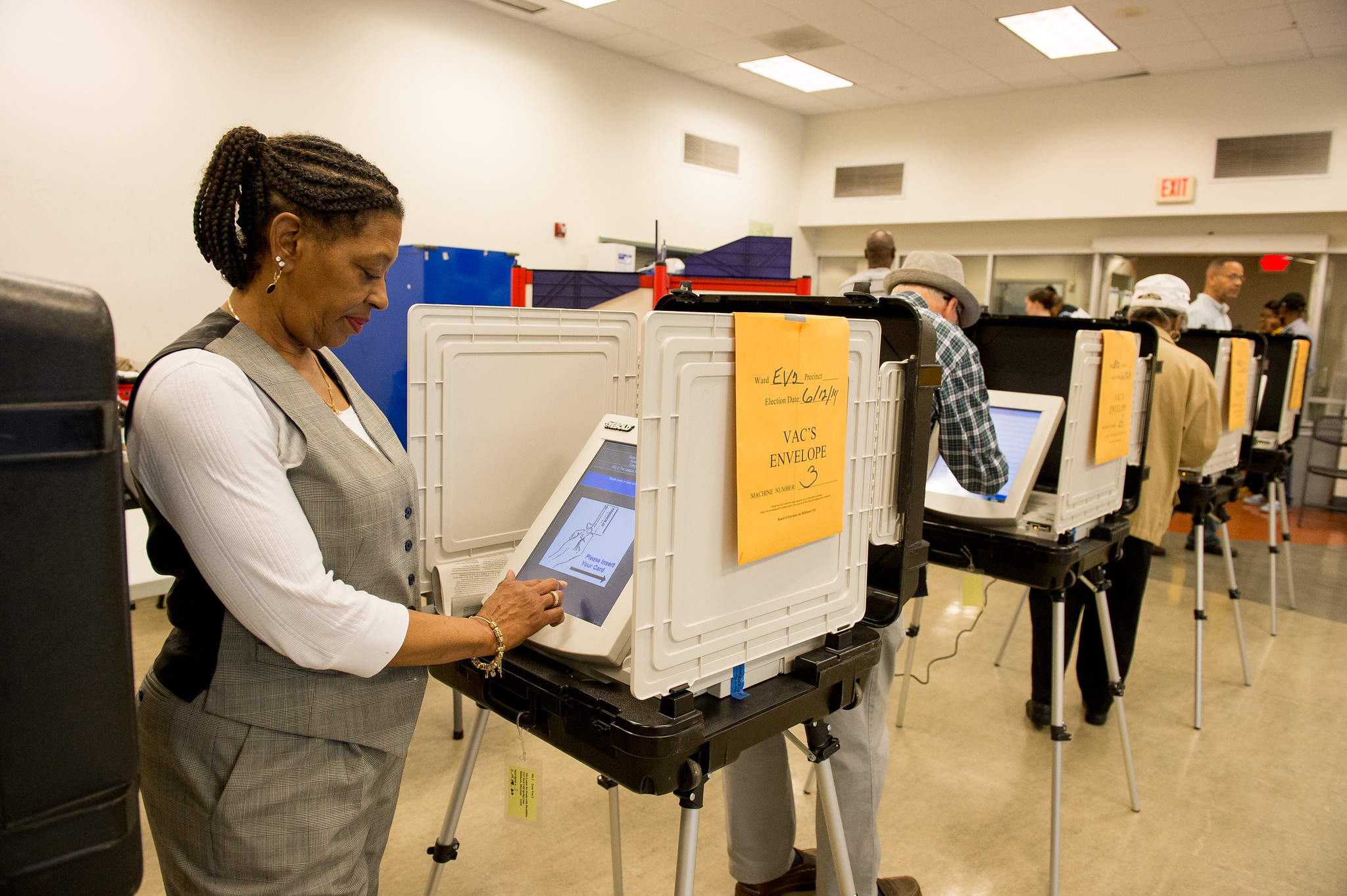
Governor Votes Early Donna Brazile writes in Ms. magazine that in the elections of 2008 and 2012, the group that turned out to vote in the highest numbers was black women. In 2012, 60 percent of 18- to 29-year-old-black women voted, and 76 percent of all black women were registered to vote. A recent Pew study found that in 2012, the voter turnout in the United States was low—53.6 percent of the estimated voting-age population. Only 65 percent of the US voting-age population even bothered to register to vote. Brazile cites “The Power of the Sister Vote” poll from Essence magazine, which indicates that the turnout will again be strong for black women in 2016, “driven by a hunger to institutionalize their gains” in:

  • Increased affordable health-care access
  • Quality education reform and access to low-cost college education
  • Living-wage reforms
  • Criminal justice reforms
But the frustration levels are high for political candidates like Donna Edwards, an African American woman who just lost the Democratic primary race for a Senate seat in Maryland. Jill Filipovic writes in the New York Times that while the Democrats rely on black female voters, only one black woman has ever been elected to the Senate. In addition, while Trump accuses Clinton of playing the “woman card,” Edwards, during her primary race, was accused of playing both the “woman card” and the “race card.” The implication is that these “cards” somehow confer unearned advantages to the women holding them. Yet research shows that for black women, combined stereotypes about both race and gender create double challenges for them to be perceived as competent leaders and elected, or hired, to leadership positions. Filipovic suggests that the problem, in general, is that authority, competence, and power are perceived to be male qualities. Several recent studies show that when the same résumés are shown to both male and female evaluators, the documents are rated more highly when they have a man’s name, John, on the top than when the same documents have a woman’s name, Jennifer, at the top. Filipovic proposes that to fight pervasive prejudices, we need to change our images of competence and power by putting more women, especially more women of color, into positions of authority and leadership so that women in authority becomes normal rather than unusual. Specifically, she says, “we can’t change longstanding assumptions about what a leader looks like unless we change what leaders look like. . . . Democrats should make [the ‘woman card’ and the ‘race card’] central components of a winning hand.” She also suggests that when there are equally qualified men and women competing for positions, Democrats should champion politicians who are not white men. It’s the only way that, in the long run, we are all going to win.   Photo credit: Governor Votes Early. by Jay Baker at Baltimore, MD. via Maryland GovPics on Flickr]]>