 The Covid-19 pandemic has shown that “women’s work,” or the care economy, is essential work. In a recent article, I wrote about the essential infrastructure workers whose jobs were deemed too important to be halted in the pandemic but who are also usually underpaid, undervalued, and unseen. These roles are also overwhelmingly filled by women and, specifically, women of color. Lyric Thompson and Gawain Kripke of NBC News report that a growing number of policymakers in the United States are calling for a domestic “feminist response” to the pandemic. Representative Jackie Speier, D-CA, explains that a feminist policy response means “treating women as the essential workers they’ve always been” by providing
- Economic security with a fifteen dollar per hour minimum wage
- Hazard pay
- Universal paid family and medical leave
- A robust safety net
- Subsidized childcare
- Domestic violence prevention funding
New research, reported by Thompson and Kripke, calls for a feminist foreign policy as well. This report shares a reason why female leaders appear to have more success in fighting the pandemic: the female leaders emphasize “empathy, human dignity and care rather than pitting the formal economy against the goal of saving lives.”
Thompson and Kripke note that the new research, based on a broad review of feminist policies in other countries, a global summit of government leaders, and consultation with activists in forty countries, refines the global picture into a tailored vision of what feminist foreign policy would look like. Here are the key points from their findings. A feminist foreign policy would
- Call for a feminist economic recovery, similar to what the state of Hawaii has done, that prioritizes the care economy and the health and well-being of the most marginalized: indigenous women, women of color, incarcerated people, aging women, domestic violence survivors, and LGBTQIA+ people.
- Reconceptualize the idea of “national interest”—a shift from prioritizing military security, profit, dominance, and competition toward putting people’s health and personal safety, peace, and inclusion first. It’s an approach that invests in public health around the world, lifting up and caring for the most marginalized, and it emphasizes collaboration and learning.
- Emphasize the importance in the international arena of cooperation and care, including restoring funding to the World Health Organization, reinvesting in the UN Family Planning Program, leading global efforts to respond to gender-based violence, returning to the Paris Climate Agreement and making new commitments to go beyond those goals, consciously supporting female farmers, and investing in the indigenous women who organize communities to salvage ecosystems and foster resilience.
Having a domestic and foreign feminist policy approach is possible. Thompson and Kripke note that several other countries are in the process of implementing policies that require equal numbers of women and men in leadership positions and taking women’s rights issues into account in matters from trade to immigration to diplomatic engagement and aid programs. It’s possible in the United States too.
Photo by Graham Ruttan on Unsplash
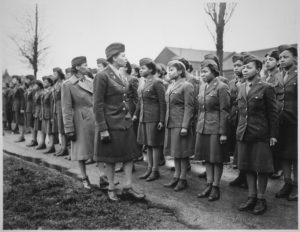 In this era of the murder of George Floyd and the attention his death has brought to structural racism in this country, the story of Lieutenant Colonel Charity Adams offers a glimpse into structural racism in the 1940s in the United States Army to remind us how far we have to go. Christina Brown Fisher, of the New York Times, notes that in 1942, the newly created Women’s Army Auxiliary Corp (WAAC, later shortened to WAC) accepted “
 Some time ago, a woman coaching client asked me to name women in history who I admired. She was looking for role models and inspiration. I could name one or two, but I was basically stumped. I promised myself that I would read more about women in history so I could share these role models with others. Here are a few fascinating women I had never heard of before reading about them who have inspiring stories:
 The coronavirus lockdown has pulled aside the curtain between family life and work life for women and men with children. Claire Cain Miller, writing for the New York Times, notes that
 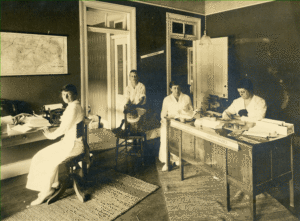 This is the year, 2020, when we should be celebrating one hundred years since women won the right to vote. Actually, it was only white women who won the right to vote in 1920 as the white suffragists turned their backs on black women suffragists to get the votes of Southern senators. That is a shameful chapter in our history that I wrote about
  The COVID-19 pandemic offers us a global case study in leadership, and women are proving to be significantly more effective leaders. Avivah Wittenberg-Cox, writing for Forbes, notes that “there have been years of research timidly suggesting that
  I have long been worried about a backlash against the #MeToo movement that could make things worse in the long term for women who experience and report sexual harassment and assault. I have worried and talked with others about the need for us to develop a consensus about what the consequences should be for a broad range of sexual harassment behaviors in the workplace, the military, and on college campuses. The #MeToo movement has been vitally important for empowering women to call out the degrading and harmful treatment that they, and some men, have experienced from people with more power—usually but not always men. People who are targets of sexual harassers often experience fear, depression, loss of confidence, and/or damaged careers.
 In response to the COVID-19 pandemic when businesses and social gatherings were shut down or restricted, only “essential workers” were allowed to leave their homes and travel to work. Who turns out to be “essential”? Campbell Robertson and Robert Gebeloff of the New York Times report that an analysis of census data cross-referenced with federal government guidelines for essential workers shows that one in three jobs held by women in the United States
  Over the years I have repeatedly noticed and wondered why the people who run for national office always seem to be wealthy. One of the exciting aspects about the 2018 election was the unusual number of women of color and working class people who ran and were elected to the House of Representatives. Isabella Grullón Paz, writing for the New York Times, explains that often women of color and working-class people who decide to run for office must
  I remember when I first learned from a search firm that women over age fifty-five were considered “too old to hire” by many of their clients. I was leading a search for a new leader for an organization, and the search firm we hired asked whether we wanted them to bring us women over fifty-five years of age as potential hires. They said that most of their clients would not consider an older woman as a candidate, and they didn’t want to waste their time or ours. We were shocked, and we told them that we considered women over fifty-five to be perfectly fine potential leaders. And, unlike many of their clients, we actually hired an older woman.