
Gender Bias Still Strong in Economics

Ben Casselman of the New York Times writes that a body of evidence has been building for awhile that shows a deeply ingrained gender discrimination in the field of economics. Casselman notes that studies in recent years have shown that

  • Women are less likely than men to be hired and promoted as economists.
  • Women face greater barriers to getting their work published in economic journals.
  • Gender and racial gaps in economics are wider and have narrowed less over time than in other fields.

In response to the findings from these earlier studies, Casselman reports that the American Economic Association commissioned a survey of more than nine thousand current and former members to ask about their experiences in the field. Their report, published in 2019, found that

  • A large number of harassment and sexual assault cases exist.
  • Only one in five women reported being “satisfied with the overall climate” in the field.
  • One in three believed they had been discriminated against.
  • Nearly half reported that they had avoided speaking at a conference or seminar because they feared harassment or disrespectful treatment.

A new study conducted by Dr. Alicia Sasser Modestino and Dr. Justin Wolfers, in a working paper soon to be published by the National Bureau of Economic Research, found that women received 12 percent more questions than men when presenting papers at economics conferences, and they were more likely to get questions that were patronizing or hostile. Modestino and Wolfers gathered this data by recruiting dozens of graduate students across the country to attend hundreds of economic presentations and record what happened. While research presentations at conferences are collegial and respectful affairs in other fields, Casselman notes that they resemble aggressive gladiatorial battles in the field of economics. This hostility is perhaps a key reason why Modestino and Wolfers found that “half of women are saying they don’t even want to present in a seminar.” In fact, another study found that women accounted for fewer than a quarter of the economics talks given in recent years, with racial minorities even more underrepresented.

As mentioned previously, the disrespect that women experience when giving presentations results in women wanting to avoid speaking. This dynamic, in combination with the fact that women are less likely to be invited to present their research in the first place, has long-term consequences for women’s careers in economics. Casselman points out that economists need to disseminate their research at conferences to build their reputations and get feedback on their work. The field of economics has a lot of work to do if the talents of women and racial minorities are to be heard and valued. The culture of conferences could become less hostile and aggressive, and the biases in hiring, promotion, and publication need to be identified and weeded out. A lot of valuable ideas and talent are being lost.


Photo courtesy of Financial Times (CC BY 2.0)
More Barriers Fall for Women

Being the first woman to do something seems to be happening more frequently now across a wide spectrum of roles and industries. It is important to take this moment to notice and mark them. We know there is no guarantee that opportunities will stay open to women unless we stay vigilant. Here are some recent “firsts” for women.
Jane Fraser

Jane Fraser will become the first woman chief executive of an American megabank, Citigroup, in 2021. Emily Flitter of the New York Times writes that Citigroup is one of the four largest banks in the United States. Fraser has occupied several global senior leadership roles at the bank in recent years. As research has shown, though, women are often given top corporate jobs when an organization is in trouble. Fraser is no exception as she takes over as CEO of Citigroup in the midst of serious regulatory and financial problems at the bank.

Rashida Jones

Rashida Jones will become the first Black woman to take charge of a major television network, MSNBC. She has held several senior roles and advanced steadily up the ladder at MSNBC. As president of the network, she must now figure out how to retain viewers who found a safe space there for their rage about Donald Trump now that he has left office.

Suzanne Clark

Suzanne Clark became the first woman to lead the US Chamber of Commerce as chief executive. Her appointment became effective in March 2021. Lauren Hirsch explains that the CEO of the Chamber of Commerce is one of the most powerful jobs in business. Clark’s appointment ends a twenty-four-year run by Thomas J. Donohue, who focused his power on backing the Republican Party for much of his tenure. Clark intends to shift the chamber to be an advocate for bipartisan moderation. Previously, in her role as president of the chamber, she helped start the Equality of Opportunity Initiative, which aimed at closing racial wealth gaps.

Ngozi Okonjo-Iweala

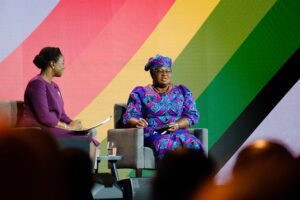
Dr. Ngozi Okonjo-Iweala became the first woman and first African to serve as director-general of the World Trade Organization (WTO) in March 2021. As Ana Swanson writes, “Dr. Okonjo-Iweala takes the helm of the W.T.O. at a particularly difficult time for the global trade body. . . . It has fallen short on several of [its goals].” Swanson also points out that “the organization’s system for dispute settlement also remains crippled after challenges from the Trump administration.”

Maral Javadifar, Lori Locust, and Sarah Thomas

Maral Javadifar and Lori Locust became the first women to coach in the NFL Super Bowl, and Sarah Thomas became the first woman to work as a Super Bowl official in 2021. Change is slow in the NFL, but some is happening.

Claire Cain Miller reminds us that progress and achievements “can be taken away if we don’t work to sustain it.” She points out that political scientists think representation matters in three main ways:

  • Representation in positions of influence can break down stereotypes about who can be a leader.
  • Research from around the world has demonstrated that a role model effect is especially strong for young girls, summarized as “if you can see it, you can be it.”
  • The identities of leaders shape which issues they pay attention to and how they do their job. When women make up an equal presence of decision makers, it increases public trust in decisions.

All the women identified as barrier breakers in this post are facing tough challenges. As previously noted, women are often not elevated to senior position until organizations elevating them face a crisis, which is true for most of the women mentioned here. They are going to need us at their backs.


Photo courtesy DFID – UK Department for International Development (CC BY 2.0)

The Truth about Rosa Parks: How Change Really Works

I had the good fortune to spend a week at the Highlander Institute in New Market, Tennessee, as part of my graduate education. Attendance at a Highlander program was required to complete of my doctorate degree specialization in transformative learning for social justice. At Highlander I learned the truth about Rosa Parks and how change really works.

The Highlander Folk School (which later became the Highlander Institute) was established in 1932 by Myles Horton in the Tennessee hills and initially focused on labor organizing and adult education. According to the Stanford University page about them, “by the early 1950s, however, it shifted its attention to race relations. Highlander was one of the few places in the South where integrated meetings could take place, and served as a site of leadership training for southern civil rights activists.” The Ku Klux Klan menaced them regularly. Rosa Parks and Martin Luther King Jr. were among the activists who spent time there building the civil rights movement.

Like most white Americans, I grew up with the myth of Rosa Parks as a simple seamstress, cast as meek, tired, quiet, and middle class, whose single act on a Montgomery bus changed the course of history. Jeanne Theoharis of the New York Times writes that this is a narrow, distorted, and inaccurate view of Rosa Parks. In fact, the truth about Parks is much more interesting and informative about how change really happens.

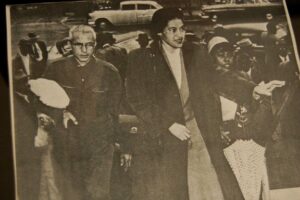
Theoharis tells us that Parks, born in 1913, had been a civil rights activist for two decades before her historic refusal to give up her seat in the “whites-only” section of the bus in Montgomery, Alabama, in 1955. Before her famous bus stand, she focused tirelessly on voter registration, criminal justice, and desegregation. She attended leadership and movement strategy sessions at the Highlander Institute in the early 1950s where civil rights activists planned actions to challenge Jim Crow segregation laws. Refusing to get up from a seat on the bus was one of many strategies planned, and fifteen-year-old Claudette Colvin was arrested in March 1955 for refusing to give up her seat on a bus. At the time Black Montgomerians decided she was not the right test case. Parks was the next to try it. The combination of her timing and the networks in place, ready to spring into action when she did, resulted in the launch of the successful bus boycott on the day Parks was to be arraigned in court. It took organization and a lot of people to pull off the boycott. Theoharis notes, “The boycott succeeded in part because the Black community organized a massive car pool system, setting up some 40 pickup stations across town, serving 30,000 riders a day. . . . The boycott seriously disrupted city life and bus company revenues.”

Parks and her husband both lost their jobs, received regular death threats, and never found steady work in Montgomery again. Forced to leave Montgomery for Detroit, they struggled financially for the next eleven years. Rosa Parks spent the next several decades fighting racism in the North. In the 1960s and 1970s she was part of the Black Power movement. “Freedom fighters never retire,” she observed about a friend—and she never did either.

Parks fought her whole life against racism, which she saw as a national cancer. Her real story helps us to see our country’s history more honestly and understand that change comes from only disrupting the status quo and persevering to push for change. We must all do our part to get rid of the cancer of racism in this country.


Photo courtesy of Matt Lemmon (CC BY-SA 2.0)

Updates on the Shecession: Current Research on Working Mothers

Early in the pandemic I wrote a post about the potential long-term impact of the pandemic on working mothers in the United States. Now, several months later, new studies reveal the following bad news for working mothers:

  • The Bureau of Labor Statistics reports that in the first ten months of 2020, women lost 5.4 million jobs—nearly 1 million more than men. Women of color suffered a higher proportion of these losses overall, and in December 2020, Black, Hispanic, and Asian women suffered all the women’s job losses.
  • Vice President Kamala Harris notes in the Washington Post that women in low-wage industries such as hospitality and health care, many of them women of color, have been hit the hardest. She also writes that in February 2020, before the pandemic, around five million women were business owners. By April, one in four had closed their doors for good. The numbers are worse now.
  • Gina M. Raimondo and Mary Kay Henry cite in the Washington Post a report from the US Department of Labor in October 2020 showing that of the 1.1 million people age twenty and older who left the workforce between August and September, 865,000, or about 86 percent, were women who dropped out of the labor force. This includes 324,000 Latina women and 58,000 Black women and is more than four times the number of men who dropped out.
  • Helaine Olen notes in the Washington Post that a study by the Center for American Progress “revealed one-third of unemployed women under the age of 40—the ‘millennial mothers’—said the reason they were not working was that they needed to mind the children.” Olen points out that “women’s workforce participation rates are now what they were in the late 1980s. Decades of women’s progress at work and at home have been wiped out in a matter of months.”
  • Wendy Wagner Robeson at the Wellesley Center for Women cites a recent Lean In study showing that “one in three mothers may be forced by the pandemic to scale back their hours or leave the workforce entirely.”
  • Research from the Undefeated Survey on Race and Health found 32 percent of Black mothers say the pandemic has had a major negative impact on their ability to pay for basic necessities like housing, utilities, and food. Pew Research data shows that the number of single Black and Hispanic mothers who are employed fell by nearly twice as much as for single white mothers.

What are the long-term implications of the pandemic for working mothers? The Center for American Progress reports that:

  • A thirty-three-year-old woman in the United States with an annual salary of $50,000 stands to lose $571,223 over her lifetime by taking five years off of work for childcare.
  • A thirty-three-year-old woman earning $50,000 per year who leaves the work force for five years can expect to lose $157, 704 in retirement assets and benefits, assuming she retires at age sixty-seven.

Helaine Olen points out that because of what’s happened to women’s employment in the pandemic, women twenty-five, forty, and even fifty years from now will be receiving smaller social security checks when they retire.

Raimondo and Henry suggest that going forward, women, particularly women of color, must have affordable pathways to higher-wage industries, subsidized college tuition, paid family leave and sick leave, and affordable quality childcare. Economic recovery depends on parents being able to work and paid a living wage. Now is the time for the United States to get systems in place to support working families. Our economy is badly damaged. Let’s do what it takes to “build it back better.”


Photo courtesy of Ran Allen (CC BY 2.0)

The History of Tipping: Why Restaurant Wages Are So Low

A long time ago I worked as a bookkeeper for several small restaurants. As I prepared payroll checks, I often wondered why servers were paid less than the minimum wage—a lot less. The current hourly wage is still very low: $2.13 per hour for restaurant servers. I never heard or read an explanation for this low wage until now. A recent article by Michelle Alexander entitled “Tipping Is a Legacy of Slavery,” really opened my eyes. She explains that she came to understand the history of tipping in the United States when she read a book by Saru Jayaraman entitled Forked: A New Standard for American Dining.

Alexander notes that “after the Civil War, white business owners, still eager to find ways to steal Black labor, created the idea that tips would replace wages.” While tipping originated in Europe as a way for aristocrats to show favor to servants as bonuses, restaurant owners in the United States mutated the idea into a way to limit pay for Black workers by defining tips as the only source of income. The Pullman Company tried to get away with this to underpay train porters who were predominantly Black, but the porters formed a union and eventually got higher pay. Restaurant workers, mostly women and disproportionately Black, were not able to unionize. In fact, Alexander explains, when the Roosevelt administration signed the first minimum wage law in 1938, it excluded restaurant workers. It was not until 1966 that a subminimum wage was formally created for tipped workers, locking the tipped workforce, which is 70 percent female and disproportionately Black and brown women, into a subminimum wage, currently $2.13 per hour. Alexander points out that the subminimum wage “continues to perpetuate both race and gender inequity today,” which has been made even worse by the pandemic. Specifically, Alexander points out that

  • A mostly female, disproportionately women of color workforce of tipped workers still faces the highest levels of harassment of any industry.
  • Women restaurant workers in the forty-three states with subminimum wage standards report twice the rate of sexual harassment as women working in the seven states that pay a full minimum wage on top of tips. These women are not as dependent on tips and feel more empowered to reject harassment.
  • The pandemic has exasperated the vulnerability of subminimum wage restaurant workers as customers now subject them to “mask harassment” in order to earn tips. With tips down 50 to 75 percent, male customers know women are desperate.
  • Before the pandemic, Black women who were tipped restaurant workers made five dollars per hour less than their white male counterparts, who more often work in fine dining establishments. Black women tend to work in casual dining restaurants where tips are lower.
  • In the pandemic nearly nine in ten Black tipped workers report their tips decreased by half or more, compared to 78 percent of workers overall.
  • In addition, tipped workers are now required to do more for less—enforcing social distancing and mask rules, which creates hostility and further reduces their tips.

The pandemic and a new president of the United States have created an opportunity to fix this egregious legacy of slavery with new minimum wage legislation, the Raise the Wage Act. This legislation will raise the minimum wage overall and fully phase out the subminimum wage for tipped workers. The restaurant industry pays millions of dollars a year to fight pay raises, but it is time that tipped workers were paid a full and fair living wage. Let’s all encourage our congressional representatives to support the Raise the Wage Act.


Photo by Danny Kang on Unsplash