
Forgotten Women in History—Part III

Some time ago, a woman coaching client asked me to name women in history who I admired. She was looking for role models and inspiration. I could name one or two, but I was basically stumped. I promised myself that I would read more about women in history so I could share these role models with others. Here are a few fascinating women I had never heard of before reading about them who have inspiring stories:

Eunice Foote (1819–1888)

John Schwartz writes that in the 1850s, Eunice Foote, an amateur scientist and activist for women’s rights, made a remarkable discovery about greenhouse gases that might have helped form the foundation of modern climate science—had the paper she published on her research not been lost and forgotten. Her paper was presented at the American Association for the Advancement of Science—but it was presented by a male scientist. Roland Jackson, a scientist and historian wrote, “Foote does seem to have been the first person to notice the ability of carbon dioxide and water vapor to absorb heat, and to make the direct link between variability of these atmospheric constituents and climate change.” Katharine Hayhoe, a climate scientist who is currently working to bring recognition to Foote’s work, asks us to imagine what Foote might have accomplished if she had been born today and not had to contend with the limited horizons available to women of her time.

Lillian Harris Dean (1870–1929)

Amelia Nierenberg writes that Lillian Harris Dean drifted into New York City from Mississippi in 1901 after the end of slavery, penniless. She saved her first five dollars while working as a maid in New York and used it to purchase a used baby carriage, a fifty-nine-cent tin boiler, and a charcoal stove. Dean sold traditional Southern meals from the baby carriage, an early version of a food truck, to other African American transplants like herself for whom the food brought familiarity in a strange place.

Dean built a name and a fortune as a culinary and real estate entrepreneur and philanthropist. She died one of the wealthiest women in Harlem with a fortune of about $5.5 million in today’s dollars.

 Rosa Bonheur (1822–1899)

Rosa Bonheur, described by Molly Moog of the Saint Louis Art Museum, was a critically acclaimed French painter in the mid-1800s in France. Bonheur became one of the most admired painters in Europe of contemporary subjects such as horses and other animals. Empress Eugenie of France awarded Bonheur the Legion of Honour in 1865, reflecting the Empress’s conviction that “genius has no sex.” Moog notes that in the 1850s Bonheur was one of only a dozen women in France to receive a legal permit to wear men’s clothing. Her trousers allowed her to enter spheres generally forbidden to women, enabling her to study animal musculature at the Parisian horse fair and at slaughterhouses, sketch outdoors, and ride comfortably.

Irene E. Karl (1915–2006)

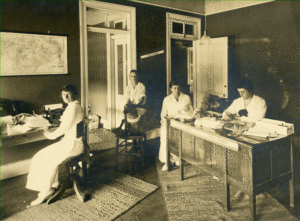
A recent photo of five women published in the St. Louis Post-Dispatch asked, “Do you know who these women are?” This search for the women’s names was part of an effort during Women’s History Month to correct the historical lack of recognition women have endured in the sciences. The photo, taken in 1942–43, showed one Dr. Michael Somogyi, a physician and biochemist at now Barnes-Jewish Hospital, with five women in white lab coats. While Dr. Somogyi was identified in the picture, the five women were labeled as “five female laboratory assistants.” Within seventy-two hours after the photo was published, one of the women, Irene E. Karl was identified by her daughter.

Joe Holleman of the Post-Dispatch writes that Dr. Irene E. Karl was a renowned biochemist who was a pioneer in identifying and understanding diabetes and sepsis (blood poisoning) and was an authority on muscle metabolism. She graduated summa cum laude in 1937 from the University of Wisconsin—the only woman in a class of four hundred. Then she went on to become the first woman in school history to earn a doctorate degree in a science, biochemistry.

Rebecca Ortenberg, social media director of the Science History Institute in Philadelphia, first posted the photo. She explains, “Women scientists are often invisible in the historical record, even when they’re staring right at us.”

Thanks to all those who made the four amazing women featured in this article visible to the rest of us.


Photo by Geoffrey Datema on Unsplash

What the Coronavirus Lockdown Reveals about Parents Who Work

The coronavirus lockdown has pulled aside the curtain between family life and work life for women and men with children. Claire Cain Miller, writing for the New York Times, notes that parents, especially mothers, are expected by employers to keep family caregiving a private matter, not to be discussed or allowed to interfere with work responsibilities. During a recent consulting project at a large corporation, senior women shared with me in focus group discussions that “we have learned not to mention our families at work. Having a family is seen as a barrier to promotion, so we don’t mention them, even to each other. As women, we do each other a disservice not to talk about family challenges. We should share how we deal with them, but we don’t talk about this.”
The realities of family life are now on full display during the lockdown as women and men try to work full time from home while dealing with homeschooling, housework, and childcare. Just yesterday, during a business Zoom call, the three-year-old child of my client demanded attention “right now” and crawled into her mother’s lap in the middle of our call. She was very cute and an example of how it is no longer possible to hide the realities of family life.

The pandemic lockdown has also revealed the unequal distribution of labor in heterosexual couples. Claire Cain Miller writes in another article that while both women and men are doing more housework and childcare, a new poll by the New York Times of 2,200 Americans who work full time at home with children found the division of labor is not any more equitable now than it was before:

  • Of those polled, 70 percent of women say they’re fully or mostly responsible for the housework during lockdown, and 66 percent say so for childcare.
  • About 20 percent of men say they are fully or mostly responsible for these tasks during lockdown. Only around 2 percent of women agree.

Past research has consistently shown that men often overestimate the amount they do. In one humorous and enlightening example reported by Motoko Rich about this same problem in Japan, Rich gives the example of one couple where the man in the couple believed and declared he was doing a fair share of domestic chores during the lockdown. His wife then produced a meticulous spreadsheet showing her 210 tasks compared to his 21. He got more involved.

Miller further explains, “The additional time that women typically spend on domestic work, particularly child care, has significant consequences outside the home: It is a major reason for their lower pay and stunted career paths.” During the pandemic, research shows that women are doing less paid work when both parents are working remotely full time, which may have career consequences. In an article by Caroline Kitchener in the Lily, she notes that women in academia are submitting 50 percent fewer papers for publication during the lockdown, which “threatens to derail [their] careers” when institutions decide who to grant tenure to. At the same time, submissions for publication from men have increased more than 50 percent as they rely on women partners to do homeschooling and housework.

Will anything change after COVID-19 for working parents now that the challenges of family life are more visible? Miller notes that “unlike people in other advanced nations, American parents have little structural support.” She suggests that perhaps employers and the federal government will “recognize the need for things like paid leave, affordable child care, predictable schedules, reasonable hours and remote work.” Miller cites Joan Williams, director of the Center for WorkLife Law at the University of California, Hastings, as saying, “The idea that if you want to be perceived as professional, you have to make believe like you don’t have children or other responsibilities? That’s certainly over for the time being, and I’d be surprised if it ever comes back in quite the same way.” Let’s hope not.


Photo by Jerry Wang on Unsplash

100 Years Ago: When Women Won the Right to Vote during a Flu Pandemic

This is the year, 2020, when we should be celebrating one hundred years since women won the right to vote. Actually, it was only white women who won the right to vote in 1920 as the white suffragists turned their backs on black women suffragists to get the votes of Southern senators. That is a shameful chapter in our history that I wrote about in a previous article. But my point today is based on an interesting piece in the New York Times by Alisha Haridasani Gupta about the parallels between 1920 and 2020.

All the big celebrations planned for 2020 to celebrate the passage of the Nineteenth Amendment in 1920 have been canceled because of the COVID-19 pandemic. Large gatherings and celebrations cannot take place this year as we battle this virus. Gupta points out that the Spanish flu pandemic of 1918 also had a direct impact on the women’s suffrage movement. The campaign to secure women’s right to vote had built strong momentum in 1918, which, Gupta notes, was “quickly dissipate[d] in 1918 as the country shut down public gatherings and ordered people to stay home” to fight the Spanish flu pandemic. In fact, the Nineteenth Amendment came close to passing in 1918 and had the backing of the president, Woodrow Wilson, but fell two votes short of passing in the Senate. One of the key reasons it failed in the Senate was because Southern senators were afraid of black women being able to vote. Gupta cites the work of Elaine Weiss, author of The Woman’s Hour: The Great Fight to Win the Vote. Weiss explained that the Southern senators objected because they held “the idea that if black women can vote, they might think they’re socially equal too and then the whole premise of white supremacy is eroded.”

Forced to abandon public rallies and campaigning, the suffragists “burned up the telephone lines and sent letters and took ads in newspapers,” according to Weiss. They were fighting for the election of senators who would vote for women’s suffrage. Indeed, they defeated the antisuffrage lawmakers and voted in new prosuffrage ones. The next year both the House and Senate approved the Nineteenth Amendment, and it was ratified as a constitutional amendment in 1920. Weiss notes that the suffragists persisted and “used all the tools of democracy . . . to change the system.”

Here we are in 2020, in the middle of the COVID-19 pandemic in a very important election year. We can learn from our foremothers about not letting a pandemic stop us from working to save our democracy. If they could make phone calls and write letters to get candidates elected who supported their cause, we can too. Let’s get busy. November will be here before we know it, and there is no need to let the current pandemic keep us from being engaged.


Photo courtesy of State Archives of North Carolina Raleigh, NC (The Commons)

Women Lead More Effectively in Pandemics: Four Leadership Traits Men Could Learn from Women

The COVID-19 pandemic offers us a global case study in leadership, and women are proving to be significantly more effective leaders. Avivah Wittenberg-Cox, writing for Forbes, notes that “there have been years of research timidly suggesting that women’s leadership styles might be different and beneficial.” She points out that we have some very clear and measurable examples of those differences and the beneficial outcomes of the leadership styles of seven women who are heads of state. Here is the data from the European Centre for Disease Control as of May 19, 2020:

Country Leader No. of Deaths

(as of 5/19/20)

Denmark Mette Frederiksen 548
Iceland Katrín Jakobsdóttir 10
Finland Sanna Marin 300
Germany Angel Merkel 8,007
New Zealand Jacinda Ardern 21
Norway Erna Solberg 233
Taiwan Tsai Ing-wen 7

Now compare these numbers with the United States under President Donald Trump: 90,353 deaths (as of 5/19/2020).

Wittenberg-Cox cautions us not to dismiss these results just because some of these countries are small: Germany is large and leading other large European and North American countries in keeping cases and deaths low. Wittenberg-Cox offers these leadership lessons from the seven woman leaders listed above:

Lesson #1: Telling the Truth—Angela Merkel of Germany stood up early and calmly and told her citizens that the virus was very serious. Testing began immediately, and Merkel was transparent about the testing results.

Lesson #2: Decisiveness—Tsai Ing-wen, the leader of Taiwan, was among the first and fastest to respond to the virus. In January, she introduced 124 measures to block the spread and never had to resort to lockdowns. In fact, she sent 10 million masks to the United States and Europe.

Jacinda Ardern of New Zealand locked her country down early and was truthful and concise with her citizens about the danger of the virus. She continued to add restrictions when other countries began lifting them.

Lesson #3: Use of technology—Iceland, under Prime Minister Katrín Jakobsdóttir, offers free testing to all citizens and utilizes a thorough tracking system. Consequently, she has not needed to lock down or shut schools.

Sanna Marin, elected in Finland in December 2019 as the world’s youngest head of state, leads the way with the use of social media influencers to spread fact-based information to help manage the pandemic.

Lesson #4: Empathy and compassion—Mette Frederiksen, prime minister of Denmark, and Erna Solberg, prime minister of Norway, pioneered the idea of using television to talk directly to the countries’ children. By responding to the questions of children and explaining why it was okay to feel scared, they demonstrated empathy and care rarely seen from leaders who are men. In fact, Wittenberg-Cox notes that all the women leaders showed empathy and compassion when communicating with their citizens about the pandemic.

“Now,” writes Wittenberg-Cox, “compare these leaders and stories with the strongmen using the crisis to accelerate a terrifying trifecta of authoritarianism: blame-‘others,’ capture-the-judiciary, demonize-the-journalists . . . (Trump, Bolsonaro, López Obrador, Modi, Duterte, Orban, Putin, Netanyahu . . . ).” Wittenberg-Cox suggests that the seven women leaders profiled here offer lessons in leadership traits that “men may want to learn from women” for the health of the planet and her inhabitants.


Photo by Jan Kaluza on Unsplash

The Maturing of #MeToo

I have long been worried about a backlash against the #MeToo movement that could make things worse in the long term for women who experience and report sexual harassment and assault. I have worried and talked with others about the need for us to develop a consensus about what the consequences should be for a broad range of sexual harassment behaviors in the workplace, the military, and on college campuses. The #MeToo movement has been vitally important for empowering women to call out the degrading and harmful treatment that they, and some men, have experienced from people with more power—usually but not always men. People who are targets of sexual harassers often experience fear, depression, loss of confidence, and/or damaged careers.

Let’s be clear—sexual harassment is still a huge problem. Here are two examples in the United States:

The problem is that, until now, the only consequence for people accused of sexual harassment during #MeToo has been removal from their jobs without an investigation, as happened with Al Franken in the United States Senate. Legal proceedings against egregious offenders like Harvey Weinstein have been rare. While removal and sometimes arrest are warranted for the most severe behaviors, such as rape and assault, a whole range of behaviors can reflect sexual harassment that is less severe, and we do not have a spectrum of appropriate responses for holding people accountable for those behaviors. The short-term backlash for women’s careers from having only one response—removal—is already happening. Various research shows that

  • In 2019, 60 percent of male managers in the United States reported they are “uncomfortable engaging in commonplace workplace interactions with women, including mentoring,” which is a 14 percent increase from 2018.
  • Over one-third (36 percent) of men who are uncomfortable explained that they are “nervous about how it would look” or of having their intentions misunderstood.
  • In addition, research by Sylvia Ann Hewlett found that two-thirds of male executives hesitate to hold one-on-one meetings with junior women. This is problematic because women have to be sponsored by leaders to succeed, and leaders are still mostly men.

Jeannie Suk Gersen, writing for the New Yorker magazine, notes that the #MeToo movement burst forth in 2017 to reveal the widespread sexual exploitation in many forms experienced primarily by women. She makes the case, using the accusations against Joe Biden by Tara Reade, that this case may be a pivotal moment for #MeToo, “which marks its more mature reckoning with its deeper goals.” In other words, we and #MeToo may finally be ready to develop a more nuanced commitment to due process. We may be ready to come to an understanding of the range of behaviors, from mild to severe, that can be inappropriate and constitute abuses of power. We can develop a range of consequences that can be applied to those behaviors to hold abusers appropriately accountable and create safe work environments where women can speak out and prosper.

It is not my intention to take a side in the Biden versus Reade allegation but rather to take a position for expanding our commitment to fair processes for all concerned and for appropriate consequences for bad behavior. Gersen writes that a key slogan associated with #MeToo, “believe women,” was never intended to be taken literally because that would be an “idea . . . untenable for a social-justice movement that cares for truth and nondiscrimination.” Gersen notes that Biden himself said that “believing women means taking the woman’s claim seriously when she steps forward, and then vet it” or do a thoughtful investigation. I agree with Gersen when she says, “‘Believe women’ stands for the imperative to listen respectfully and investigate thoughtfully. It is not about the right to be believed, much less automatically vindicated, but essentially a right to be heard and to have one’s claims examined with care. We should also see that #MeToo means calling out sexual misconduct while also accounting for the moral and practical balance needed in states of not knowing.”

In the case of Joe Biden, Tina Tchen, the CEO of Time’s Up, makes the case that “you have to look at the whole picture. I would assess these candidates on their character, on the policies that they promote and put forward, and the leadership abilities that they have.” I believe we can create fair processes. It’s time to do so.


Photo by Nastuh Abootalebi on Unsplash